Imagine the biggest, most diverse family on Earth deciding to live together in one house. The article of Indian Constitution ensure harmony, they need a set of rules that everyone agrees on—a rulebook that promises fairness, protects the weak, and lays the foundation for a shared future. That rulebook, for the family of over 1.4 billion Indians, is the Article of Indian Constitution.
More than just a legal document, it is the bedrock of the world’s largest democracy. It’s a visionary map that transformed a newly independent nation into a sovereign republic. This article will journey through the making, the core principles, and the living relevance of this remarkable document, breaking down its complexities into simple, engaging insights.
Historical Background: The Foundation of a Dream
The story of the Article of Indian Constitution is inextricably linked to the story of India’s struggle for freedom. For centuries under British rule, Indians were subjects, not citizens. The demand for Swaraj (self-rule) evolved into a demand for a system built on justice and equality.
Key milestones paved the way:
- The Nehru Report (1928): An early Indian attempt to draft a constitution for a dominion status.
- The Demand for a Constituent Assembly: The Indian National Congress’s persistent call for Indians to frame their own constitution.
- The Cabinet Mission Plan (1946): This finally led to the formation of the Constituent Assembly.
This Assembly was no ordinary gathering. It was a mini-India, comprising 299 members from diverse regions, religions, and communities. Among them were giants like Dr. B.R. Ambedkar (Chairman of the Drafting Committee, revered as its chief architect), Jawaharlal Nehru, Sardar Vallabhbhai Patel, and Sarojini Naidu.
They debated, discussed, and deliberated for 2 years, 11 months, and 17 days. They studied constitutions from around the globe—the USA’s Bill of Rights, the UK’s parliamentary model, Ireland’s Directive Principles, and Canada’s federal structure—but tailored every borrowed idea to India’s unique social fabric.
The Article of Indian Constitution was adopted on 26th November 1949 and came into full force on 26th January 1950, a date chosen to honour the 1930 declaration of Purna Swaraj (Complete Self-Rule). We commemorate these as Constitution Day and Republic Day, respectively.
Key Features of the Article of Indian Constitution
What makes this document so distinctive? Here are its defining characteristics:
- The Longest Written Constitution: Its detailed nature stems from the need to address the vast diversity and complex historical context of India, incorporating lessons from colonial governance.
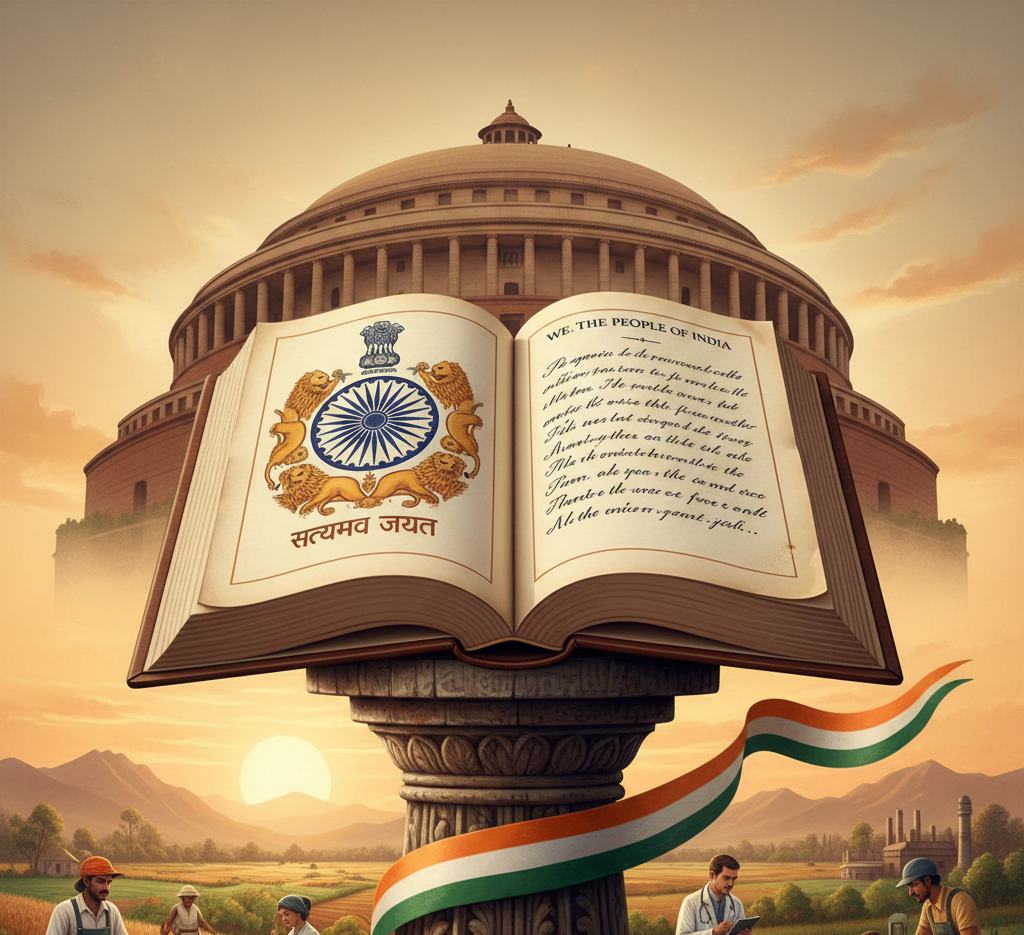
- The Preamble: The Soul of the Document: Often called its identity card, the Preamble begins with the powerful words, “We, the People of India…” It declares India to be a Sovereign, Socialist, Secular, Democratic Republic and secures for all its citizens Justice, Liberty, Equality, and Fraternity. These are not mere words but the overarching goals of the entire system.
- A Unique Blend of Rigidity and Flexibility: Some parts, like the amendment of fundamental rights, require a special majority of Parliament. Others can be amended by a simple majority. This balance allows the Constitution to be stable yet adaptable.
- Federal System with a Unitary Bias: India is a “Union of States.” While power is divided between the Centre and States (with separate governments and lists of subjects), the Constitution grants stronger powers to the Centre in emergencies, finance, and legislation, ensuring national integrity.
- Parliamentary Form of Government: The real executive power lies with the Prime Minister and the Council of Ministers, who are directly responsible to the popularly elected Lok Sabha. The President is the constitutional head of state.
- Integrated and Independent Judiciary: The Supreme Court stands at the apex, acting as the guardian of the Indian Constitution and the final interpreter of the law. Its power of Judicial Review allows it to strike down laws that violate constitutional principles.
- Secularism: The Indian model of secularism means the state respects all religions equally, has no official state religion, and can intervene in religious matters to ensure equality and social justice (e.g., abolishing untouchability).
Fundamental Rights and Duties: The Citizen’s Charter
This is the chapter that touches every Indian’s life directly.
Part III: The Shield – Fundamental Rights
These are justiciable rights, meaning you can go to court if they are violated. They act as a shield against state authority and majoritarian excess.
- Right to Equality (Articles 14-18): Equality before law, prohibition of discrimination, equality of opportunity.
- Right to Freedom (Articles 19-22): Freedom of speech, assembly, association, movement, residence, and profession.
- Right against Exploitation (Articles 23-24): Prohibition of forced labour and child labour.
- Right to Freedom of Religion (Articles 25-28): Freedom of conscience and to profess, practice, and propagate religion.
- Cultural and Educational Rights (Articles 29-30): Protection of minority interests.
- Right to Constitutional Remedies (Article 32): Dr. Ambedkar called this the “heart and soul” of the Constitution. It gives you the right to move the Supreme Court to enforce your fundamental rights.
Part IV-A: The Responsibility – Fundamental Duties
Added by the 42nd Amendment in 1976, these 11 duties remind citizens that rights come with responsibilities. They include respecting the Constitution, upholding national unity, protecting public property, and preserving the natural environment.
Directive Principles of State Policy: The Nation’s To-Do List
Often described as the “conscience of the Article of Indian Constitution,” the Directive Principles (Part IV) are guidelines for the government to frame laws and policies. They aim to create a welfare state and establish social and economic democracy. While not legally enforceable in court, they are “fundamental in the governance of the country.”
Examples include securing a living wage, promoting village self-government (Panchayats), providing free legal aid, and protecting the environment. Landmark laws like the MGNREGA (right to work) and the Right to Education Act find their roots in these principles.
Significance in Contemporary India: A Living Document
The true test of a constitution is its relevance over time. The Article of Indian Constitution has passed this test by evolving.
- A Tool for Social Justice: It has been the primary weapon for transformative movements, enabling affirmative action, protecting tribal rights, and advancing gender justice through progressive judicial interpretations.
- Amendments: Adapting to Change: The Constitution has been amended over 100 times to meet new challenges. Key amendments include:
- 1st Amendment (1951): Placed reasonable restrictions on free speech.
- 42nd & 44th Amendments: Reflected the tensions of the Emergency era and its aftermath.
- 73rd & 74th Amendments (1992): A revolutionary step that empowered grassroots democracy by giving constitutional status to Panchayati Raj institutions and urban local bodies.
- 86th Amendment (2002): Made education a fundamental right for children.
- 101st Amendment (2016): Introduced the Goods and Services Tax (GST), overhauling the indirect tax system.
- Navigating Modern Challenges: Today, the Article of Indian Constitution is the framework for debates on digital privacy, data protection, climate change, and balancing national security with civil liberties. The judiciary, using constitutional principles, regularly addresses issues from LGBTQ+ rights to the regulation of online speech.
Conclusion: An Enduring Covenant
The Article of Indian Constitution is far more than ink on parchment. It is a dynamic, living covenant—a profound promise that a nation made to itself at the dawn of its liberty. To view it merely as a historical artifact or a legal manual is to miss its true essence. It is, in fact, a continuous practice, a daily reaffirmation of the ideals that bind a breathtakingly diverse population into one democratic whole.
Its enduring strength lies in its remarkable duality. It is both an anchor and a sail. As an anchor, it provides unwavering stability through its basic structure, fundamental rights, and democratic framework. It prevents the ship of state from being tossed adrift by the volatile waves of populism or majoritarian impulse. As a sail, it captures the winds of change and social progress through its amendable nature and the expansive interpretation of its principles by a vigilant judiciary. It allows the nation to journey forward, adapting to new realities—from the digital age to environmental crises—without losing its foundational bearings.
The most compelling chapter of the Article of Indian Constitution’s story, however, is not written in its articles or amendments. It is written in the daily lives of ordinary citizens. It is present in the student who questions authority, the voter who stands in line, the activist who files a Right to Information application, and the community that uses the Panchayati Raj system to shape its own development. The Constitution lives when we cite our rights, but it truly thrives when we voluntarily fulfill our duties—when we embrace the spirit of fraternity by respecting difference and protecting the dignity of others.
In an era of global uncertainty and complex domestic challenges, the values enshrined in the Preamble—Justice, Liberty, Equality, and Fraternity—are not just aspirational goals; they are necessary tools for national survival and flourishing. They form the indispensable compass for India’s ongoing journey.
Therefore, the ultimate relevance of the Article of Indian Constitution depends less on its textual perfection and more on the constitutional morality cultivated by its people. It calls for a society where respect for the rule of law, tolerance, and reasoned debate become ingrained cultural habits. As we move forward, our shared task is to move beyond ritualistic reverence for the document. We must engage with its spirit, debate its applications passionately but responsibly, and hold it close as our common manual for building a more inclusive, just, and resilient India. The Article of indian Constitution has given us the framework; it is up to ‘We, the People’ to breathe life into its noble promise, every single day.