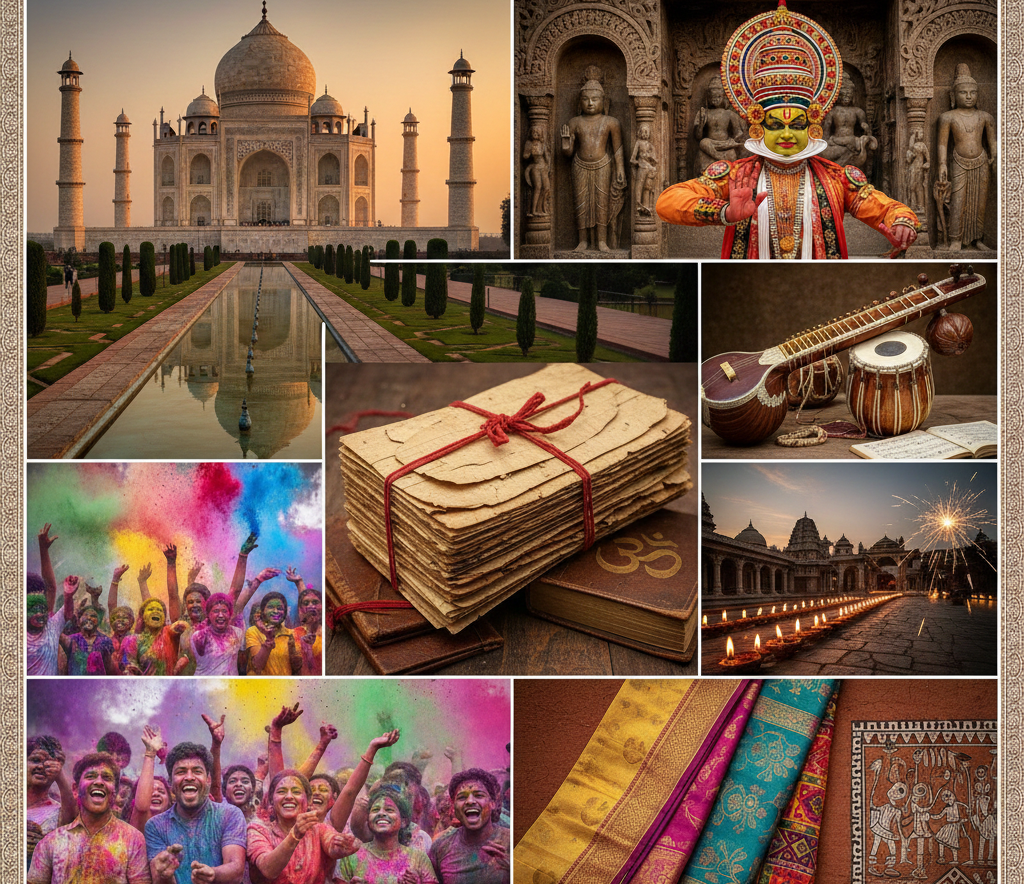
Indian Culture Heritage; India is not merely a country, it is an ancient, whispering civilization. To speak of its Indian cultural heritage is to describe a vast, intricate tapestry woven over five thousand years, where each thread represents a dynasty, a philosophy, a conquest, an art form, or a humble village tradition. It is a Indian cultural heritage that is not frozen in museums but breathes in the incense of temple corridors, resonates in the rhythm of a street-side drum, and bursts forth in the vibrant chaos of its festivals. This blog is an invitation to explore that living tapestry, understanding its patterns, its resilience, and its profound relevance in our globalized world.
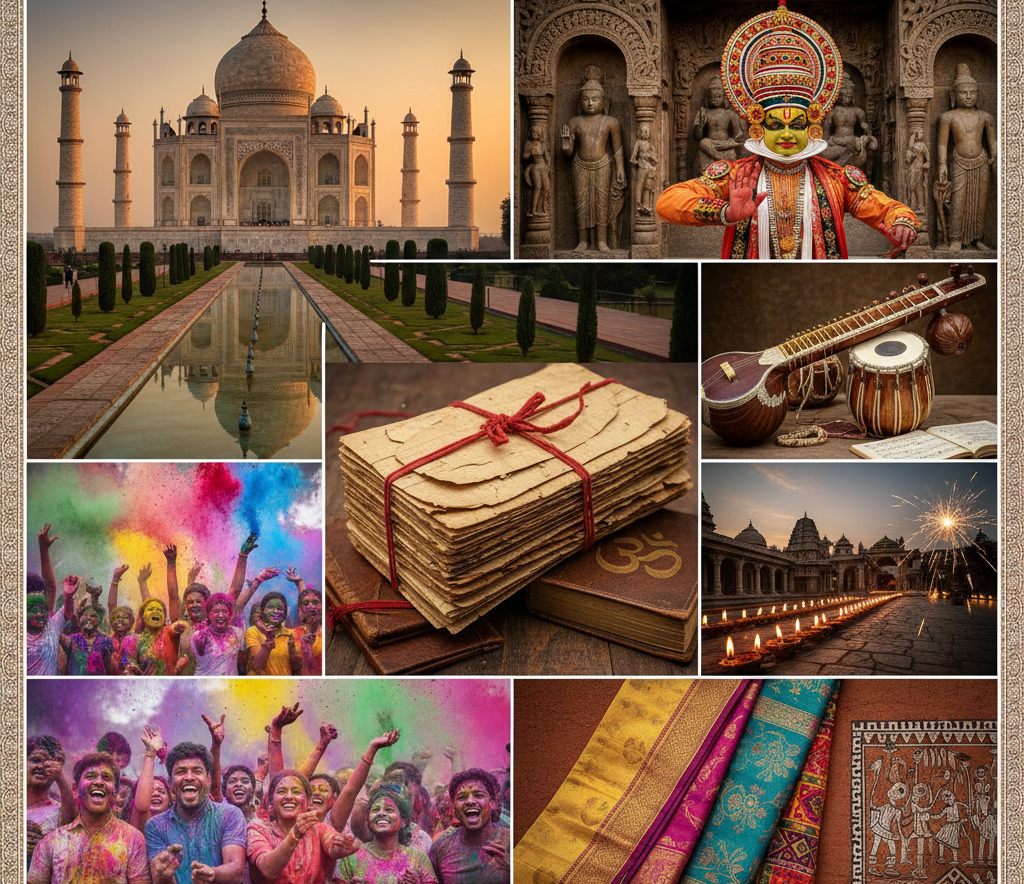
1. Introduction: The Symphony of Continuity
In Indian culture heritage imagine standing at the ghats of Varanasi at dawn. A priest chants Sanskrit verses older than many modern languages, while a smartphone camera clicks nearby. A silk sari with motifs unchanged for centuries brushes past jeans and a t-shirt. This is the essence of India’s Cultural Heritage: a breathtaking symphony of continuity and change. It is a palimpsest, where layers of history—Indigenous, Hindu, Buddhist, Jain, Islamic, Persian, Central Asian, and European—are all visible, none completely erasing the other, but each adding a new verse to an ongoing epic. Our exploration begins by tracing the hands that wove this complex fabric.
2. Historical Overview: The Layers of Time
The sophisticated Indus Valley Civilization laid Indian culture heritage (c. 3300–1300 BCE), known for its urban planning, artisanal crafts, and mysterious script. The subsequent Vedic period introduced the foundational Sanskrit texts—the Vedas, Upanishads, and epics like the Mahabharata and Ramayana—which established the philosophical bedrock of Dharma (duty/righteousness), Karma (action), and Moksha (liberation).
The classical age (c. 3rd century BCE to 6th century CE) under the Mauryas and Guptas was a golden era. This period gave us the rock-cut architecture of Ajanta and Ellora, the secular moral philosophy of Emperor Ashoka’s edicts, and timeless treatises on statecraft (Arthashastra), performance (Natya Shastra), and medicine (Ayurveda). The arrival of Islam from the 8th century onwards, culminating in the Mughal Empire, introduced profound new influences: the sublime geometry of Mughal architecture (the Taj Mahal being its zenith), miniature painting, new musical instruments like the sitar, and a rich culinary legacy.
Colonial rule, particularly under the British, was a period of confrontation and synthesis. While it exploited and disrupted traditional economies, it also spurred a renaissance of Indian thought and a unified nationalist movement that itself drew upon Indian cultural heritage symbols for mobilization. Each epoch was not a clean break but an absorption, a dialogue, and a transformation.
3. Key Traditions and Practices: The Rhythms of Life
Indian culture heritage is deeply encoded in daily practices and life-cycle rituals. These are not mere formalities but the glue of societal and spiritual life.
- The Concept of Dharma and Karma: Beyond religion, Dharma is one’s righteous duty within one’s role in society and stage of life. Coupled with Karma—the law of cause and effect—it forms an ethical compass that emphasizes responsibility and the long-term consequences of one’s actions.
- Yoga and Ayurveda: Often reduced globally to physical postures, Yoga is a holistic spiritual, mental, and physical discipline for unifying consciousness. Ayurveda, its sister science, is a complete medical system based on balance within the body and with nature. Their revival speaks to a heritage of wellness that is timeless.
- Family and Societal Structure: The joint family system, though evolving, emphasizes collective responsibility and intergenerational bonding. The traditional greeting Namaste (I bow to the divine in you) encapsulates a worldview that sees the sacred in every individual.
- Cuisine as Heritage: Food is deeply ritualistic and regional. It is medicine (anna is brahma—food is divine), an act of community (communal dining, langar in Sikhism), and a marker of identity. The use of spices is a science perfected over millennia.
4. Regional Diversity: A Subcontinent of Worlds
To speak of a monolithic “Indian culture heritage” is a grave error. India is a federation of cultural republics, each with its own language, attire, cuisine, and art forms.
- The North: Influenced by Persian and Central Asian flows, seen in the Mughlai cuisine, Kathak dance, and the Urdu language’s poetic legacy.
- The South: Home to ancient Dravidian traditions, magnificent Dravidian temple architecture (like the towering gopurams of Tamil Nadu), classical Bharatanatyam dance, and the rhythmic Carnatic music system.
- The East: The land of monsoon-green landscapes, delicate rice-based cuisines, the lyrical Odissi dance, and the profound intellectual traditions of Bengal, which produced Nobel laureates and a film maestro like Satyajit Ray.
- The West: The arid landscapes of Rajasthan produce vibrant textiles and folk music, while Gujarat’s penchant for enterprise coexists with its intricate Garba dance. The coastal states like Goa and Maharashtra bear the imprint of Portuguese and Maratha histories, respectively.
- The Northeast: Often underrepresented, this region is a mosaic of Tibeto-Burman and Tai cultures, with unique matrilineal societies (like the Khasi), vibrant handloom traditions, and distinct festivals like Hornbill.
This diversity is India’s greatest strength—a proof of its civilizational capacity to host a multitude of worlds within one.
5. The Double-Edged Sword of Globalization
Globalization has profoundly impacted this Indian culture heritage, acting as both a catalyst for erosion and a tool for preservation.
Challenges:
- Homogenization: Fast food, Western attire, and global pop culture can dilute local traditions, especially among urban youth.
- Commodification: Sacred rituals and symbols can be stripped of context and sold as exotic products or quick spiritual fixes.
- Erosion of Crafts: Mass-produced goods threaten the livelihoods of master weavers, potters, and other artisans, risking the extinction of centuries-old skills.
Opportunities:
- Global Platform: Indian classical music, yoga, cinema (Bollywood and beyond), and literature now have a worldwide audience, fostering cross-cultural appreciation.
- Digital Preservation: Projects are digitizing ancient manuscripts, documenting folk songs, and creating virtual tours of heritage sites.
- Revival through Demand: A global interest in sustainable, handcrafted goods has spurred a revival in khadi (hand-spun cloth), organic Ayurveda, and traditional jewelry. The diaspora plays a key role as cultural ambassadors and consumers.
The dance is now between adaptation and preservation. The Indian cultural heritage that survives will be that which can find relevance in the modern imagination without losing its soul.
6. Art, Music, and Festivals: The Heartbeat of Expression
Indian culture heritage finds its most vibrant expression here.
- Art: From the ancient sensuousness of temple sculptures at Khajuraho to the intricate Mughal miniatures, from the bold narrative scrolls of Bengal (Patachitra) to the tribal art of Gond and Warli, Indian art is a conversation between the sacred and the mundane, nature and the divine.
- Music & Dance: The two classical systems—Hindustani (North) and Carnatic (South)—are complex, spiritual journeys based on ragas (melodic frameworks) and talas (rhythmic cycles). Folk traditions like Rajasthan’s haunting Manganiyar songs or Punjab’s energetic Bhangra provide the grassroots pulse. Dance, from the devotional storytelling of Bharatanatyam to the elegant circular movements of Manipuri, is seen as a form of worship.
- Festivals: The Indian calendar is a whirlwind of festivals. Diwali, the festival of lights, celebrates the triumph of good over evil. Holi is a cathartic spring festival of color and equality. Eid, Christmas, Gurpurab, and Paryushan are celebrated with equal fervor, reflecting a secular fabric. Regional festivals like Onam (Kerala) or Durga Puja (West Bengal) are spectacular cultural carnivals involving community art, music, theater, and feasting. They are the ultimate performance of heritage, renewing social bonds and passing traditions to the next generation.
Why This Heritage Matters Today?
Indian culture heritage is a masterclass in resilience, adaptation, and synthesis. It teaches us how multiple faiths, traditions, and ideas can coexist and enrich one another. In a fast-paced globalized world, reconnecting with these roots offers a profound sense of identity, continuity, and sustainable wisdom.
1. An Antidote to Modern Anonymity: Identity in a Homogenizing World
As global culture flattens distinctions, India’s heritage offers a profound sense of identity and belonging. Knowing the stories behind a festival, the stitches in a local textile, or the ingredients in an ancestral recipe connects us to a continuum larger than ourselves. It answers the question “Who am I?” not just individually, but as part of a grand, intricate tapestry of human history and community. This rootedness combats the dislocation of the digital age.
2. A Blueprint for Sustainable and Mindful Living
Long before “sustainability” became a buzzword, Indian heritage encoded it in daily practice.
- Ayurveda and seasonal festivals remind us to live in harmony with natural cycles.
- The handloom sector and traditional crafts champion slow, ethical production over mindless consumption.
- Concepts like ‘Vasudhaiva Kutumbakam’ (the world is one family) and respect for all life forms provide an ancient philosophical foundation for modern environmental and humanitarian ethics.
3. A Toolkit for Innovation Through Fusion
Indian culture heritage is one of constant, creative synthesis—integrating new influences without losing its core. This is the ultimate skill for the 21st century. Today’s innovators, artists, and entrepreneurs can draw inspiration from this heritage of fusion—be it in Indo-Western fashion, fusion music, or modern architectural design that incorporates traditional principles like Vastu Shastra for climate-responsive buildings. The past teaches us how to adapt without erasure.
4. Building Social Cohesion and Emotional Resilience
The shared experience of Indian culture heritage—singing the same folk songs, celebrating a festival with neighbors of different faiths, participating in a community dance—builds unbreakable bonds of social trust and empathy. In times of personal or collective stress, these traditions, from communal meals to spiritual practices like yoga and meditation, provide a tested framework for emotional resilience and mental well-being.
Conclusion: Preservation as a Dynamic Act
Preserving Indian culture heritage is not about embalming the past in amber. It is a dynamic act of remembering, reinterpreting, and revitalizing. It is crucial because:
- It anchors identity: In a rapidly changing world, it provides a sense of belonging and continuity.
- It holds wisdom: Ancient systems like Ayurveda or water management techniques offer sustainable solutions for modern problems.
- It fosters pluralism: India’s heritage is a masterclass in “unity in diversity,” a crucial lesson for a fractured world.
Preservation, therefore, means supporting the artisan, teaching the child a folk song, understanding the philosophy behind a ritual, and choosing the handloom over the fast fashion copy. It is a conscious choice to keep the tapestry alive, allowing new threads—including global ones—to be woven in, but ensuring the original design, with all its glorious complexity and color, continues to tell its story for millennia to come. The living tapestry endures not by being kept behind glass, but by being worn, celebrated, and rewoven by every generation.